I really wish I could say that I spend hours upon hours writing, reading and honing the craft, so to speak. As a mother to two charismatic, chaotic toddlers, unfortunately, that just isn’t the reality. Most days, I get little to no writing done during daylight hours. What little I do manage is scraps of sentences or ideas jotted into my phone’s notes app, recorded on a Dictaphone or simply scribbled on a scrap of paper; those last ones are the worst because usually I can’t read my own writing by the end of the day.
Misadventure was planned in a haze of Post-it notes and written in the car parked at various locations relevant to the story. I found it helpful to be able to look around and see the reality of these places; what hours were more densely populated, how the weather affected the environment and such. However, if you are following my social media, you may have caught snippets of the creation of the Study/Writing room/home office. It is still a work in progress, but already it has proven useful when I can escape to it. So, allow me to take you on a tour of my creative space.
We begin, as with any room, at the door, which I painted black with chalkboard paint. It has certainly proven useful as an area I can scribble an idea or map the answer to a question. This is especially helpful when I just need to sit and think; my notes or thoughts are right in front of me and easy to wipe away and edit. While I am a hoarder of notebooks, I love being able to hash out a thought and decide if it is feasible before I take up numerous pages only to cross them out.
The furthest corner from the door, hidden by the chimney breast, is home to the Plot Board (yes, this is the official title in my head). Generally, this is taken up with a map in one corner of the area I am basing the current Work In Progress in, an A3 page covered in post-it notes mapping out the key plot points I have envisioned and Suspect and Victim profile pages. The suspect and victim profile pages are laminated in order to make them reusable and minimise paper waste where I can. Having these elements in one location lets me see how the storyline I am plotting is aided or impeded by the landscape of the area, as well as showing me how the key players’ character development will affect the plot. Will I need to change a plot point or a character trait? How would the environment be managed in, for example, a storm or a fire? What is the road map from point A to point B? What could happen along that route? Occasionally, I can be found staring at that board in varying states of irritation because I have discovered a plot hole or a flaw in the plan.
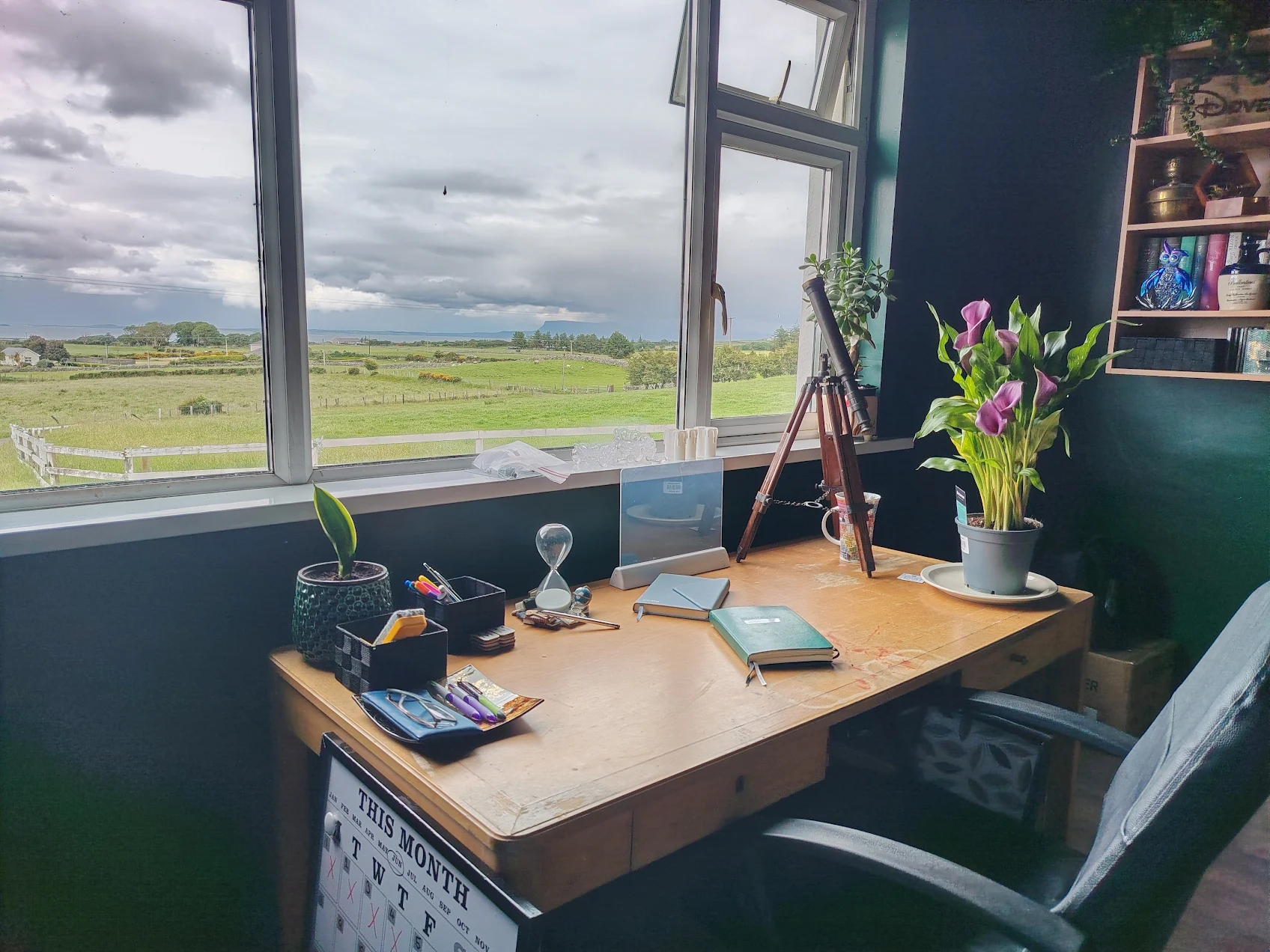
There are two desks in the room (really need to give it a title, don’t I?), both of which were donated by my long-suffering, always supportive mother. They’re chipped here, stained there, and showing some wear, but hey, at 38 years old, so am I. One desk sits near the Plot Board, and it has been delegated the electronics desk. It holds the charging cables, Bluetooth speaker base and essentially anything electronic. The other desk, my desk, sits in front of the window. This is where I write, looking out at the Atlantic Ocean and spotting parts of Donegal across the water. Because truthfully, I think I need an element of the outdoors to feel like I can write. The shallow drawers hold paper and pens, and a small basket of chalk for the door chalkboard. The desktop is cluttered at best, with my planning journal, an hourglass, a plant and an antique telescope. While I do use my laptop at this desk, forcing myself to charge it in the other corner stops me from getting too sucked into what I’m doing.
The bookshelf is another second-hand/recycled piece, and its contents are constantly changing. There are books on languages, writing methods, thesauruses and story structure. One shelf holds the notes, plans and current prints for the Work In Progress, another is currently full of knick-knacks, although that will no doubt change when the mantlepiece is put over the fireplace. On the floor underneath the bookshelf lie the bags of photography equipment. One bag, the sensible one, holds the DSLR camera, a couple of lenses and a cleaning kit. The other bag (not so sensible) holds a variety of gadgets for taking photos on my phone, not essential, but certainly fun.
I’m still not finished with the room. The aforementioned mantlepiece is on its way, and a light fitting is also from my mother. I tried to find as much as possible second-hand or recycled, collecting whiteboards and notice boards in second-hand shops and various knick-knacks picked up at car boot sales or antiques fairs. As time goes on, I expect the décor will grow and change, and the plants may die (hopefully not). But for now, I have a space to retreat to where I can spread out and organise my notes, work out my plots and write to my heart’s content. At least, that is, until my laptop battery begins to die.
Ta-ta for now, come back next time for an introduction to the community and characters of Misadventure, where we step from the very real town into the very fictional people.
Until next time!
Marian